(800) 210-7017
The kit you choose sits at the dead center of your hair service, because it decides how many platelets actually reach the scalp, how clean and repeatable each run is, and what your real cost-per-procedure looks like. Most clinics fixate on the kit’s sticker price when the numbers that matter are platelet recovery and concentration above whole-blood baseline. Get those right and the rest of the service follows.
Expert Summary
A PRP kit is a single-use, FDA-cleared Class II system that draws, spins, and concentrates a patient’s platelets to roughly three to seven times whole-blood baseline for scalp injection, with quality judged by platelet recovery rate rather than marketing claims.
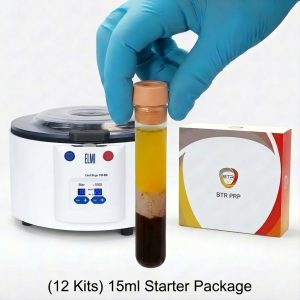
Here’s what’s actually happening inside that tube. You’re taking a patient’s own blood, spinning it until it sorts by density, and pulling off the thin platelet layer that carries the growth factors your treatment depends on. The biology only works if you deliver a viable, concentrated platelet dose, so a kit that captures the layer cleanly is doing the real work.
Pro Tip
PRP works by concentrating a patient’s own platelets well above their normal circulating level so the growth factors they release can push miniaturized follicles back into the anagen growth phase.
Don’t let anyone tell you the design choice is cosmetic. Single-spin versus double-spin, leukocyte-rich versus leukocyte-poor, closed versus open: each axis changes your yield, your sterility, and how the product behaves in the scalp. For hair specifically, most clinics land on a clean platelet harvest with low red-cell contamination, which steers them toward closed double-spin or well-validated single-spin systems.
| Design axis | Option A | Option B |
|---|---|---|
| Spin method | Single-spin gel: fast, modest concentration | Double-spin: higher concentration, more handling |
| Leukocyte content | Leukocyte-rich: retains white cells | Leukocyte-poor: depletes them, often preferred for scalp |
| System type | Closed: no open-air contact, costs more | Open: manual pipetting, higher contamination risk |
| Build | Simple tube-based kit | Proprietary device platform |
Technical Verdict
The single biggest design split is single-spin gel-separator kits versus double-spin kits, with double-spin yielding higher concentration factors at the cost of more handling steps and processing time.
Quality comes down to a simple question: how many viable platelets land in the final injectate, and how reliably does the kit hit that mark every time. The concentration factor gets the headlines, but recovery rate is where cheap kits quietly fail, wasting much of the platelet pool with the discarded red cells. Remember that the patient’s own blood sets the ceiling, so a good draw matters as much as a good kit.
Critical Insight
Platelet recovery rate, the fraction of drawn platelets that actually end up in the final PRP, separates a well-designed kit from one that wastes most of the available platelet pool.
Here’s the nuance that trips up clinics: FDA clearance covers the device that makes the PRP, not a claim that PRP treats hair loss. Most clinic-grade kits clear as Class II devices through the 510(k) pathway, but using that PRP for androgenetic alopecia is an off-label call. That puts clinical judgment, informed consent, and outcome expectations squarely on your practice, not the kit manufacturer.
Authority Warning
FDA clearance covers the device that prepares the PRP, not a claim that PRP treats hair loss, so using it for androgenetic alopecia is an off-label use that places consent and clinical responsibility on the practice.
The kit’s sticker price tells you almost nothing about whether the service makes money. What actually drives your margin is the fully loaded cost-per-procedure: kit, anticoagulant, draw and injection supplies, amortized centrifuge, staff time, and overhead. With sessions billed out of pocket and usually sold in packages, most clinics see a healthy gross margin once volume steadies the math.
| Cost factor | Per single kit | Per loaded procedure |
|---|---|---|
| Kit price | Roughly $40 to $200 | Folded in, sometimes doubled if two kits needed |
| Supplies and labor | Not included | Anticoagulant, draw, injection, staff time |
| Centrifuge | One-time capital | Amortizes to near-trivial at steady volume |
| Patient revenue | n/a | Several hundred to $1,000+ per session, often packaged |
Financial Verdict
A single PRP kit typically runs between forty and two hundred dollars, but the number that drives margin is the fully loaded cost-per-procedure, which a high-volume practice can cut sharply through per-unit volume discounts.
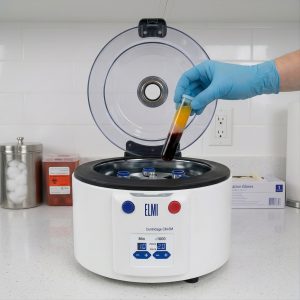
The footprint is modest if you already run injections and draws. The centrifuge is the one piece you can’t cut corners on, because it has to hit the relative centrifugal force and tube size your kit was validated for, or your yield suffers. Everything else is standard clinical stock plus a trained, properly licensed pair of hands.
Key Takeaway
A clinic already set up for routine injections and blood draws can usually add PRP with little incremental investment beyond a kit-compatible centrifuge and the kits themselves.
There’s no single best kit, only the kit that fits how your practice actually runs. The decision pivots on your patient volume first, then balances platelet yield against ease of use and sterility. Watch the red flags hardest, because a missing FDA clearance or absent platelet-yield data tells you more than any glossy brochure.
Strategic Note
The right kit is the one whose platelet yield, sterility, workflow, and total cost-per-procedure align with a specific practice’s actual volume and budget, not the product with the best marketing.
A session is a single visit, usually thirty to sixty minutes from draw to last injection. The rhythm is predictable, which is exactly why a well-validated kit and consistent technique matter so much. Set the patient’s expectations early: visible growth takes months, and PRP modifies the hair loss rather than curing it.
Expert Note
A standard PRP induction protocol runs three to four sessions spaced about four weeks apart, with visible results taking three to six months and maintenance sessions needed every four to six months.
I don’t want a sterility lapse or a poor patient screen to be the thing that hurts someone, because the PRP itself is the safe part. Since it’s autologous and re-injected the same day, you sidestep rejection and disease-transmission risk entirely. The real, controllable danger is procedural, which means it lands on your technique and your patient selection.
Safety Note
Because PRP is autologous and re-injected the same day, its most common side effects are transient scalp tenderness, swelling, and bruising, while serious complications are rare and usually tied to technique or sterility rather than the PRP itself.
The honest read is that the evidence is promising but uneven, and your patients deserve that framing straight. Multiple controlled studies and meta-analyses show PRP can raise hair count and density in androgenetic alopecia, especially in early-to-moderate cases where follicles are miniaturized but not gone. Results vary widely across studies mostly because there’s no universal PRP: concentration, leukocyte content, technique, and kit type all differ between trials.
The Bottom Line
PRP is a reasonable, low-risk option with real but variable benefit for androgenetic alopecia, best deployed on well-selected early-to-moderate patients and ideally combined with established treatments like minoxidil and finasteride.