(800) 210-7017
Most buyers fixate on the kit’s sticker price, but that number won’t tell you what a treatment actually costs you to deliver. The kit is just one line in a stack that includes reagents, draw and injection supplies, and a slice of your centrifuge spread across its working life. What you’re really chasing is cost-per-procedure, because that’s the floor you have to clear before you can price a session and still make money.
A single-use PRP kit typically runs $40 to $150, while a realistic all-in cost-per-procedure for one scalp session lands between $80 and $250 once consumables and amortized equipment are added.
What you pay for a single-use kit tracks what it’s engineered to do, not the logo on the box. The cheap end and the premium end exist because they’re solving different problems with different hardware, and most hair practices land in the middle. Just watch the quote closely, because draw and injection consumables are often priced separately and that’s where the sticker confusion starts.
Single-use PRP kits span $30 to $150, with most hair-focused practices buying in the $60 to $110 range, and negotiated standing orders typically running 15 to 30 percent below catalog list.
Here’s what most buyers get wrong: they assume the price is in the consumables they can see, when it’s actually buried in the part they can’t. The separation mechanism is what makes a medical PRP device more than a glorified blood tube, and that’s where the money concentrates. Once you know this, you can read why two kits at the same price can yield very differently.
The separation mechanism is usually the single largest cost driver inside a PRP kit, accounting for a third or more of the unit price because it carries the precision materials and intellectual property that distinguish a medical device from a plain blood tube.
You don’t get cost-per-procedure by reading the kit price off an invoice. You build it bottom-up, summing every input one treatment actually burns through, and the line most practices shortchange is their own staff time. Skip that step and you’ll price a session that looks profitable on paper while quietly losing money in the room.
A defensible cost-per-procedure is built bottom-up from kits, reagents, consumables, amortized equipment, staff time, and a wastage allowance, after which practices typically price retail at three to six times the all-in cost.
On pure marginal cost a reusable system looks dramatically cheaper, because you buy the durable chamber once and only the cheap consumables recur. That edge is real, but it’s narrower than it looks the moment you weigh in the reprocessing labor, the sterility burden, and the liability exposure that reusables drag along with them.
| Factor | Single-use kit | Reusable tube system |
|---|---|---|
| Per-session cost | Higher, predictable | Low marginal, durable part amortized |
| Reprocessing labor | None | Validated cleaning and sterilization each patient |
| Sterility burden | Closed pathway built in | Autoclave plus documented sterility assurance |
| Break-even | Wins at low to moderate volume | Favors very high procedure counts |
| Defensibility | Easy to defend | Frowned on for single-patient components |
Single-use kits win on simplicity, defensibility, and labor for most hair restoration practices, and reusable systems only pay off at high volume where rigorous sterility infrastructure is already in place.
Yield flips the whole cost question on its head. You stop asking what a kit costs and start asking what a dose of active platelets costs, because that’s the number tied to whether the patient actually grows hair. A pricier double-spin kit that hits the target with one unit can beat a cheap kit that forces a second draw to reach an adequate dose.
Yield, not sticker price, determines real cost per effective treatment, because a higher-concentration kit that adequately doses a scalp in one unit can cost less in practice than a low-yield kit that demands a second draw or a second kit.
Volume is one of the most reliable levers you’ve got on per-kit price, and the discounts climb in recognizable tiers. The catch is that bulk buying isn’t free of risk, since kits carry expiration dates and over-ordering can strand your capital in inventory that ages out before you use it.
Volume tiers move per-kit savings from roughly 10 to 15 percent on small standing orders to 20 to 30 percent on mid-volume commitments and beyond on large contracts, with group purchasing organizations the single most effective route for an independent operator.
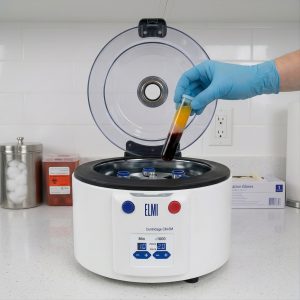
The centrifuge sits outside the per-kit price as a one-time capital buy, and the upfront number looks scary until you amortize it. Spread a unit across thousands of procedures over its working life and it quietly becomes one of the smallest contributors to what each treatment actually costs you.
A clinical centrifuge runs several hundred to roughly $5,000 or more depending on whether it’s a basic fixed-angle or a programmable swing-bucket model, but amortized across thousands of procedures over a 5-to-10-year life it adds only a dollar or two per treatment.
The kit price is never the full story, because every session pulls on a tail of small supplies that quietly stack up. Each item is cheap on its own, but across high patient volume the bundle adds real weight, and a clinic that leaves it out of the model will understate its true cost-per-procedure floor every single time.
Ancillary consumables beyond the kit commonly add $10 to $40 per session, and omitting them from the cost model systematically understates a practice’s true per-procedure floor.
Clearance and certification aren’t just a label on the box, they’re a real line in the price, and they explain most of the gap between a properly cleared device and a bargain tube repurposed for the job. The disciplined way to read that premium is as risk-reduction spend, not markup, so the right move depends on what kind of exposure you’re willing to carry.
Regulatory clearance and quality certification are a genuine embedded cost in a kit’s price, and treating that certification as risk-reduction spend rather than markup means pricing it into the per-procedure floor instead of chasing the cheaper uncleared tube.