LR-PRP vs LP-PRP for Tendons, Joints, and Aesthetics
How does leukocyte content (LR-PRP vs LP-PRP) determine which PRP kit is appropriate for a specific indication?
The white cells in your PRP aren’t passengers along for the ride. They’re an active ingredient that can either restart a stalled tendon or pour gasoline on an inflamed joint, which means the kit on your counter quietly decides which indications you can credibly treat.
Variable
LR-PRP
LP-PRP
White cell content
Above baseline whole blood
Below baseline, platelet/plasma dominant
Best-fit tissue
Chronic recalcitrant tendons
Synovial joints, skin, scalp
Typical kit hardware
Single-spin including buffy coat
Double-spin or buffy-coat exclusion
Post-injection flare risk
Moderate to severe in 15-30% of joints
Mild soreness one day
Wrong-tissue consequence
Cartilage degradation, flare cascade
Underpowered tendon response
Expert Summary
A PRP kit’s leukocyte profile is fixed by its hardware, so the kit you buy defines whether you can legitimately treat tendons, joints, or both, not just how concentrated your platelets are.
What biological role do leukocytes play in PRP and why does their concentration change clinical outcomes?
Neutrophils make up sixty to seventy percent of the white cells in a leukocyte-rich prep, and when they activate they don’t whisper, they shout. The molecules they release directly modulate the growth-factor signal your platelets are trying to deliver, and the same shout can either wake up a sleeping tendon or torch an irritated joint.
Neutrophil payload: Elastase, myeloperoxidase, MMP-2 and MMP-9, plus reactive oxygen species and IL-1 beta, IL-6, IL-8, and TNF-alpha.
Tissue-dependent effect: Reactivates fibroblasts in stalled tendons, amplifies degradation in osteoarthritic synovium.
Dose dependency: The neutrophil-to-platelet ratio within LR-PRP itself shifts the balance between regenerative and destructive signaling.
Antimicrobial bonus: Higher leukocyte counts add phagocytosis and ROS, useful for diabetic ulcers and contaminated wounds.
Technical Verdict
Neutrophils in PRP release MMPs and pro-inflammatory cytokines that reactivate healing in chronic tendons but accelerate cartilage matrix breakdown in osteoarthritic joints.
For tendinopathy and ligament injuries, does leukocyte-rich or leukocyte-poor PRP produce better outcomes and what does the evidence show?
This is one of the few places in regenerative orthopedics where the evidence is strong enough to make a confident call, but only if you respect the boundary conditions. The benefit of LR-PRP is real for the right tendon at the right stage, and far less impressive everywhere else.
Chronic recalcitrant tendinopathy (lateral epicondylitis, patellar, plantar fasciitis): LR-PRP is the better-supported choice, with Mishra’s multicenter RCT and Fitzpatrick’s meta-analyses showing durable pain and function gains versus active control.
Acute tendon or ligament injury: Skip the LR pulse. The tissue is already inflamed, so additional stimulus offers diminishing returns and can extend symptoms.
Achilles tendinopathy specifically: Results are mixed regardless of profile, likely because the tendon’s avascularity limits any PRP response.
Conservative care failure under three months: Hold off. The clearest LR-PRP benefit shows up in cases that have failed at least three to six months of structured non-operative care.
Head-to-Head Verdict
A tendinopathy-focused practice should choose a kit that produces documented leukocyte-rich PRP with verified white cell concentrations rather than trusting a marketing claim.
For knee osteoarthritis and intra-articular use, why is leukocyte-poor PRP generally preferred and what trials support that position?
An osteoarthritic joint isn’t a clean slate waiting for a signal, it’s already running a low-grade inflammatory program. Adding leukocyte-rich PRP feeds the same fire you’re trying to put out, which is exactly what direct-comparison trials keep finding.
Early-stage OA (KL grade 1-2):Both profiles can produce symptom relief, but LP-PRP avoids the post-injection flare risk with no efficacy penalty.
Best window for any PRP response; cartilage architecture still intact
Moderate OA (KL grade 3):LP-PRP clearly preferred; the Riboh network meta-analysis shows LP outperforms LR on pain and function scores.
LR-PRP performs no better than hyaluronic acid or saline in some endpoints
Advanced OA (KL grade 4, bone on bone):LP-PRP only, and even then expect limited durability; LR-PRP is poorly tolerated.
Patient counseling should set realistic expectations for any biologic injection here
The Better Pick
Leukocyte-poor PRP is the standard of care for intra-articular knee osteoarthritis because the synovial environment amplifies neutrophil-derived cytokines into accelerated cartilage degradation rather than repair.
Which leukocyte profile is appropriate for hair restoration, dermal rejuvenation, and other aesthetic applications?
Aesthetic patients judge their treatment by what their face or scalp looks like in the mirror tomorrow morning, not by a six-month outcome score. That single fact makes the leukocyte decision almost automatic, even where the published evidence is thinner than for joints and tendons.
Androgenetic alopecia: LP-PRP, with Gentile’s trials and follow-on meta-analyses showing density and follicle count gains while minimizing scalp reactivity.
Facial rejuvenation and microneedling: LP-PRP to keep visible recovery at one to two days instead of four to five.
Undereye treatment: LP-PRP because the thin periorbital skin is unforgiving of inflammatory swelling.
Source of the signal: Collagen remodeling is driven by platelet alpha-granule growth factors, not leukocytes, so excluding the buffy coat costs you very little.
Best Practice
A practice building an aesthetic PRP service line should verify the kit produces consistent leukocyte-poor preparations and ideally carries FDA clearance for the specific aesthetic indication.
How do different PRP kit designs (single-spin vs double-spin, draw volume, buffy-coat handling) physically determine whether the final product is LR-PRP or LP-PRP?
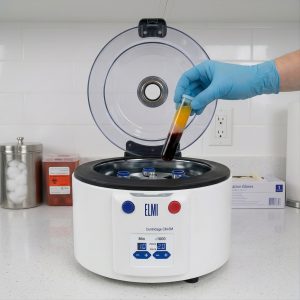
Centrifugation is just density physics, but the protocol your kit is built around dictates what ends up in the syringe. Once you understand the sequence, you can read a kit’s spec sheet and predict its leukocyte profile before any sales rep tells you anything.
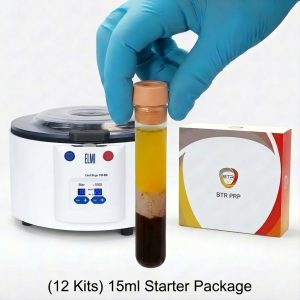
First spin separates the layers: Red cells settle to the bottom, plasma rises to the top, and the buffy coat (white cells plus platelets) sits at the interface.
Single-spin protocol: The operator draws the plasma layer plus the buffy coat into the final syringe, capturing platelets and white cells together as LR-PRP.
Second spin (when used): Re-spinning the plasma fraction at higher speed pellets platelets while leaving most leukocytes behind, yielding LP-PRP.
Draw volume effect: Forty to sixty milliliter draws support 3-5x platelet concentration; ten to fifteen milliliter draws produce lower multiples regardless of leukocyte profile.
Embedded hardware tricks: Gel separators, polymer beads that bind leukocytes, and neck-down tube geometries let some kits hit LP or LR reliably in a single spin without operator dependence.
Versatility caveat: Most kits are hardware-fixed to one profile; the few operator-controlled kits trade hardware certainty for technique-dependent consistency.
Established Fact
A practice that intends to treat multiple indications is usually safer running two dedicated kits than one versatile system, because run-to-run leukocyte variation can compromise both outcomes and protocol claims.
What adverse events and inflammatory flare patterns are associated with using the wrong leukocyte profile for a given indication?
The most common problem with a mismatched profile isn’t a catastrophic complication, it’s a patient who was promised a smooth recovery walking out with a swollen, painful joint twenty-four hours later. The flare itself is usually self-limiting, but the reputation damage isn’t.
Post-injection flare profile: LR-PRP in a joint produces moderate-to-severe flares lasting 24-72 hours in roughly 15-30% of patients.
Theoretical long-term harm: Animal data suggests repeated LR-PRP joint injection accelerates proteoglycan loss; human evidence for lasting damage remains limited.
Rare serious events: Septic arthritis from broken sterile technique, severe reactions in undiagnosed autoimmune patients, exacerbation of crystal arthropathies.
Red flags that aren’t a normal flare: Fever, erythema spreading beyond the injection site, joint instability, or pain that worsens past 72 hours instead of resolving.
Critical Warning
Patient counseling must match the kit being used, so LR-PRP recipients should be warned about a meaningful one-to-three day flare risk with a specific management plan while LP-PRP recipients can expect mild soreness for a day.
Do any published clinical guidelines, society position statements, or DEPA/PAW classification frameworks codify leukocyte-by-indication recommendations?
The PRP field built classification frameworks specifically because nobody could compare trial outcomes when every paper described its prep differently. Those frameworks are now the cleanest way to separate manufacturers who report rigorously from those who hide behind marketing language.
Framework / Body
What It Codifies
Status
DEPA (Magalon)
Dose, Efficiency, Purity, Activation
Widely cited in research; inconsistent in commercial marketing
PAW (DeLong)
Platelet concentration, Activation, White cell content (rich vs poor)
Adopted in research; neutrophil concentration as discriminator
AAOS / AOSSM
Cautious endorsement of PRP for specific indications
No prescribed leukocyte profile; left to practitioner
ISAKOS
Detailed consensus statements
Aligns with LP-for-joints, LR-for-tendons pattern
FDA (510(k))
Platelet concentration as performance spec
Leukocyte content reported but not regulated as performance
Code Requirement
A kit manufacturer that publishes DEPA or PAW validation data is signaling a level of scientific seriousness that distinguishes them from marketing-driven competitors, and that distinction should weigh heavily in your purchasing decision.
Should a practice purchase one versatile kit that can produce both profiles or stock separate kits for separate indications, and what are the economic tradeoffs?
The kit decision looks like a procurement question, but it’s really a long-range decision about which indications your practice will treat for the next several years. Versatility sounds appealing on a brochure and gets harder to defend the moment you map it against your actual indication mix.
Pure orthopedic joint practice: Standardize on one LP kit. You’ll never need LR capability, and inventory complexity is wasted overhead.
Tendinopathy-focused sports medicine practice: Standardize on one LR kit ($150-$250 each) and master one protocol.
Mixed practice (joints + tendons + aesthetic): Two dedicated kits beat one versatile platform. The inventory burden is real but consistency matters more than disposable cost.
Low-volume mixed practice: A versatile single-platform kit ($300-$500 per disposable) can pencil out economically if you accept the protocol-drift risk and invest heavily in staff discipline.
The Economics
The kit purchase decision should be driven by your planned indication mix and protocol consistency, not by sales pitch convenience or per-unit price alone, because the leukocyte capability you lock in defines what you can credibly treat.
Written by Will Lawson
Medical Affairs Manager
Will Lawson is the Medical Affairs Manager at BTR PRP, a U.S.-based provider of FDA-cleared Class II PRP kits for medical and aesthetic practices. He focuses on helping clinics lower cost-per-procedure through smarter product selection, clear patient education, and alignment with current best practices and regulatory standards in PRP therapy.