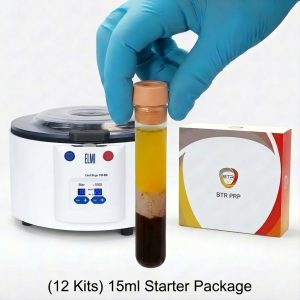
What equipment, training, and workflow requirements come with adopting a PRP kit in a clinical practice?
Adopting a PRP kit isn’t a single purchase, it’s a small operational program that quietly touches your equipment list, your staffing model, your schedule, your charting, and your sterility practices all at once. If you treat it like buying a new instrument and stop there, you’ll discover the gaps the hard way during your first booked patient.
Equipment:A kit-matched centrifuge plus a stocked draw and injection field.
Disposables outside the kit add roughly $15 to $40 per case
Staff:A licensed prescriber injects; a trained MA, RN, or phlebotomist handles draw, spin, and transfer.
Workflow:45 to 75 minutes of room and staff time per procedure, scheduled around other patient flow.
Compliance and QC:Informed consent, lot tracking, OSHA biohazard discipline, and periodic platelet-count verification.
The Bottom Line
A practice with a centrifuge-ready space, an injection-trained provider, and a designated PRP technician can integrate a PRP service line within two to four weeks of kit selection.
What centrifuge specifications and supporting equipment must a practice purchase or already own to run a given PRP kit?
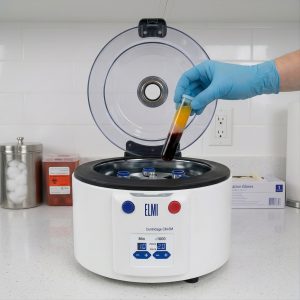
The centrifuge is the single most consequential piece of capital you’ll buy for a PRP program, and the kit manufacturer essentially writes the spec sheet for you. Mismatch the rotor type or the rpm range and you don’t just get a slightly different yield, you get a separation the kit wasn’t engineered to produce.
Spin profile: 1,500 to 3,500 rpm (roughly 400 to 1,500 g) for 3 to 15 minutes, sometimes split into two spins.
Rotor type: Swing-out gives a flat plasma-RBC interface; fixed-angle gives a sloped one. The kit is designed for one.
Tube fit and balance: Cups must accept the kit’s tube length and diameter, with an equal-mass balance tube on the opposing position.
Capital and footprint: $2,000 to $7,000 for clinical-grade units, with a one-by-one-foot countertop footprint on a stable, vibration-free surface.
Best Practice
A PRP centrifuge must match the kit’s required rpm, rotor type, and tube geometry, with annual calibration of rpm and timer documented and retained for the same period as other clinical equipment records.
What disposable supplies, draw materials, and ancillary consumables are needed alongside the kit itself for each treatment?
The kit gives you the separation tube, the anticoagulant, and a transfer device. Everything else, every needle, every drape, every milliliter of prep solution, comes out of your stockroom and has to be priced into the treatment, not absorbed quietly into overhead.
Draw side:Butterfly or 19-21G straight needles, vacutainer holders, tourniquet, alcohol or chlorhexidine pads, gauze, and tape.
Standard phlebotomy setup, replenished per case like any blood draw
Injection side:Fenestrated drape, sterile gloves, surgical prep (povidone-iodine or chlorhexidine), sterile gauze, and injection needles from 25G for aesthetics up to 18-22G for deep orthopedic targets.
Activator and transfer:A few kits include 10% calcium chloride or autologous thrombin; most don’t, so the practice sources pharmacy-grade calcium chloride or compounded thrombin and validates sterile dose prep.
Luer-lock syringes in 1 mL, 3 mL, and 10 mL plus a back-up syringe should be open on the field
Biohazard and surface:Sharps containers, red-bag liners, and EPA-registered surface wipes restocked on the same cadence as other in-office procedures.
The Practical Move
Per-case disposables outside the kit run roughly $15 to $40 depending on activator and ultrasound-probe covers, and that figure should be folded explicitly into the priced cost of treatment.
What operator credentialing and clinical training does the staff need to draw, process, and inject PRP safely?
PRP touches at least three distinct skill sets, and trying to collapse them onto a single staffer is how practices get into scope-of-practice trouble. Treat credentialing as a layered checklist, not a single sign-off, or your malpractice carrier will eventually notice for you.
The drawing and processing staff: A credentialed MA, phlebotomist, or RN can run venipuncture and the centrifuge under physician supervision, with state scope-of-practice rules naming exactly which titles qualify. Keep a competency checklist on file showing a supervised draw, a correct spin, and a successful platelet transfer, re-verified at least annually.
The injecting provider: Only a licensed prescriber (physician, PA, or NP) within their state scope performs the injection itself, and the competency is indication-specific. An intra-articular knee injector still needs separate training for an ultrasound-guided rotator cuff or a scalp grid for androgenetic alopecia.
Realistic onboarding path: Didactic review of the science combined with hands-on proctoring on three to five live cases or a cadaver lab, drawn from manufacturer courses or regenerative-medicine society programs that range from one-day workshops to multi-day fellowships.
The malpractice gate: Notify the carrier in writing before launch. Some require an explicit orthobiologics or aesthetic PRP rider, and a few exclude regenerative procedures unless coverage is added.
Regulatory Reality
The PRP injection itself must be performed by a licensed prescriber working within their state-defined scope, while draw and centrifuge work can be delegated to a credentialed MA, phlebotomist, or RN under physician supervision.
What manufacturer-provided onboarding, proctoring, and ongoing support is typically included when a clinic adopts a kit?
Manufacturer support is one of the most under-examined differentiators in the PRP market. Two kits with nearly identical specs can deliver completely different launch experiences because one ships a trainer to your office and the other ships a login to a video portal.
Tier 1 – On-site proctored launch:A clinical trainer visits the practice for one to two days to proctor the first three to five cases, calibrate the centrifuge, train the MA on draw and processing, and observe the provider’s injection technique before signing off.
Tier 2 – Hybrid remote certification:Recorded video curriculum plus a one-on-one video-proctored case and a written certification quiz, with no in-person visit.
Tier 3 – Standard documentation package:Printed and digital protocol guide, lot-tracking labels, consent template language, and patient-education brochures, with production quality and customizability varying by manufacturer.
Many also offer free outcome-tracking platforms or registry enrollment that can feed back aggregated platelet counts and patient-reported outcomes
Tier 4 – Ongoing clinical access:Regional rep plus a 1-800 clinical line, where the real test is how quickly an experienced clinical educator picks up at 4 p.m. on a Friday when a separation looks wrong.
How Pros Do It
Watch the contract for minimum-monthly-kit purchase commitments tied to discount pricing, exclusivity clauses that block competing kits during the contract term, and proctoring fees that reset annually if the injecting provider changes.
How does a PRP procedure fit into the in-office workflow from patient intake through post-injection in terms of room time and staffing?
A PRP appointment isn’t a fifteen-minute slot you can slide between two follow-ups. It’s a 45 to 75 minute door-to-door commitment that needs to be designed into the schedule deliberately or it will quietly back up the rest of your day.
Intake, consent, and landmark identification (10-15 min): Patient checks in, signs the consent and cost acknowledgment, and the provider marks the injection target.
Centrifugation (5-15 min): Single- or double-spin depending on kit protocol; tech runs the spin while injection field is prepped in parallel.
PRP transfer and activation if applicable (3-5 min): Closed-system transfer into the injection syringe; calcium chloride or thrombin added if the protocol calls for it.
Injection plus any ultrasound guidance (5-15 min): Provider executes the injection at the prepped sterile field.
Post-procedure rest and discharge (5-10 min): Patient rests, vasovagal precautions, post-care instructions issued, then discharge.
Where This Sits
A realistic half-day clinic block comfortably holds three to four PRP cases, or up to six if a dedicated PRP room with a mounted centrifuge, available ultrasound, and a stocked draw cart is in place.
What documentation, consent, and charting workflow does a PRP service line require to stay compliant and defensible?
PRP sits in a documentation gray zone that demands tighter charting than most insurance-covered work because almost every application is off-label, almost every payment is out-of-pocket, and the evidence base is still moving. Loose notes here aren’t a paperwork sin, they’re a defensibility problem if a patient or a regulator ever asks questions.
Informed consent essentials: Names the procedure, states the FDA cleared the kit only for producing PRP and not for any specific therapeutic claim, lists indication-specific risks, and captures cash price and refund policy in writing.
Per-visit chart entry: Kit brand, lot number, expiration date, draw volume, centrifuge model, spin rpm and duration, final PRP volume, anatomical target, needle gauge and depth, ultrasound use, and any activator added.
Outcome measures: Baseline and follow-up VAS or NRS pain, validated functional scores (IKDC, DASH, Foot Function Index), trichoscopy for hair, controlled before-and-after photography for aesthetics.
Financial and regulatory: Signed treatment-cost acknowledgment, clear no-refund or partial-refund policy for interrupted series, statement that PRP isn’t billed to insurance, and a state-by-state check on regenerative-medicine advertising and disclosure rules.
Code Requirement
A defensible PRP consent must explicitly state that the FDA has cleared the kit only for the production of platelet-rich plasma and not for any specific therapeutic claim, and the chart entry for each visit must record kit brand, lot number, and full processing parameters.
What infection-control, sterility, and biohazard-disposal practices must be built into the PRP workflow?
PRP is autologous, but it’s still blood moving from a patient back into their own tissues, and the infection risk concentrates at every handoff between draw, processing, and injection. The centrifuge sits outside the sterile field, which is exactly where most workflow shortcuts go wrong.
At the injection step: Surgical prep of the site, sterile gloves, a sterile field for the loaded syringe, and a single-use needle that never touches a non-sterile surface before injection.
At the processing step: Closed-system transfer devices whenever the kit supports them, unique patient-identifier labels on every tube before it enters the rotor, and hospital-grade disinfectant wipe-down of centrifuge buckets between cycles.
At the disposal step: Sharps into puncture-resistant containers at the point of use, used separation tubes and gel inserts into red-bag biohazard waste, reusable equipment cleaned per facility policy, and a documented spill protocol covering lid-engaged spins, double-gloved cleanup, and exposure reporting.
At the timing step: Processed PRP is best used within 30 minutes of separation and should not sit at room temperature beyond approximately four hours, because growth-factor release degrades and the sterility margin narrows.
Critical Warning
Processed PRP should be injected within 30 minutes of separation and never left at room temperature for more than approximately four hours, because platelet activation begins to degrade growth-factor release and the sterility margin narrows with time.
What quality-control checks and outcome-tracking systems should a practice implement to verify PRP processing and treatment consistency?
There’s no regulator forcing PRP quality control on you, which is exactly why a quietly disciplined QC program is one of the cleanest competitive moats a practice can build. Without it, you have no idea whether your kit is actually delivering the concentration factor on the brochure, and neither does your patient.
Baseline platelet verification at adoption: Run a point-of-care hematology analyzer or manual hemocytometer count on the final PRP product when the kit is first introduced, confirming the kit’s claimed concentration factor in your hands.
Trigger-event verification: Repeat the platelet count after any centrifuge calibration, when a new operator is trained, and on a rolling sample of one in every 10 to 20 cases thereafter.
Indication-specific outcome capture: VAS or NRS pain plus IKDC or KOOS for knees, DASH for shoulder and elbow, Foot Function Index for foot and ankle, validated trichoscopy for androgenetic alopecia, and standardized before-and-after photography under controlled lighting for facial aesthetics.
Monthly chart review: Look at recent PRP cases for documentation completeness and any clinical anomalies.
Quarterly outcomes meeting: Compare pain scores, function scores, and complications across operators and across lots, looking for drift before patients notice it.
Three-indicator early-warning watch: A dip in measured platelet concentration, a cluster of subpar responses, and any visible change in the PRP layer at separation, read together, flag a bad lot or a drifting centrifuge before it becomes a pattern.
The Long View
Periodic platelet-count verification on roughly one in every 10 to 20 cases gives a practice a real-world picture of whether the kit is delivering its claimed concentration factor and whether the result is consistent across operators.
Written by Will Lawson
Medical Affairs Manager
Will Lawson is the Medical Affairs Manager at BTR PRP, a U.S.-based provider of FDA-cleared Class II PRP kits for medical and aesthetic practices. He focuses on helping clinics lower cost-per-procedure through smarter product selection, clear patient education, and alignment with current best practices and regulatory standards in PRP therapy.