(800) 210-7017
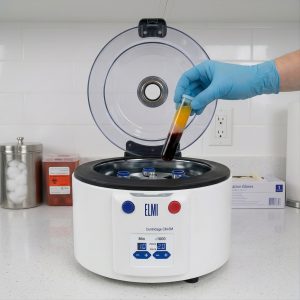
The PRP kit gets all the attention, but the kit can’t do its job without a benchtop centrifuge that can hit the manufacturer’s exact RCF, time, and rotor geometry. Think of the kit as the recipe and the centrifuge as the oven. If your oven doesn’t hold the right temperature, the recipe doesn’t matter. That’s why mismatching these two pieces is the most common reason a PRP prep fails to concentrate platelets to the therapeutic range.
A PRP kit can’t function without a benchtop centrifuge that hits the manufacturer’s validated RCF, time, and rotor geometry, and that pairing is non-negotiable for concentrating platelets to the therapeutic range.
The centrifuge isn’t picking out platelets. It’s just amplifying gravity by hundreds or thousands of times and letting density do the sorting. Whole blood stratifies into three layers under that force, and the platelet-rich band sits at a predictable spot the operator can draw from. It’s a sorting machine, not a selection machine, which is why the human technique on the draw still matters as much as the spin itself.
The centrifuge only creates the density stratification, so the final platelet count depends equally on the spin parameters and the operator’s draw technique from the correct band.
RPM is the number on the dial, but RCF is the number that actually matters to your platelets. Two centrifuges set to the same RPM will deliver different g-forces if their rotor radii differ, so copying an RPM value from one machine to another is how protocols quietly fall out of spec. The tolerance window is also tighter than most operators expect: a 10 to 15 percent drift can drop your concentration from a clinically useful 4x to 6x down into the 2x range, which is below most published therapeutic thresholds.
| Protocol | First Spin | Second Spin |
|---|---|---|
| Single-spin | 1,100g to 2,000g, 5 to 10 min | None |
| Double-spin (soft + hard) | 100g to 300g, 10 to 15 min | 1,500g to 3,000g, 5 to 10 min |
| Drift tolerance | Plus/minus 10 to 15 percent | Same window |
| Required input | RCF preferred over RPM | RCF preferred over RPM |
RCF, not RPM, is the binding specification, and the conversion (RCF = 1.118 x 10^-5 x radius in cm x RPM squared) means kit protocols cannot be safely transferred between centrifuges by copying RPM alone.
This is the question every buyer should ask before the purchase order goes out, because the answer changes who carries the regulatory burden. Some kits ship as a validated system where the FDA clearance attaches to a specific centrifuge plus a specific rotor plus a specific tube. Others publish generic spin parameters and leave the centrifuge sourcing to you. Confusing the two is how clinics end up with voided manufacturer claims and a shifted liability profile they didn’t know they signed up for.
A PRP kit’s IFU dictates whether the centrifuge is part of the FDA-cleared system or sourced separately, and the practice carries the validation burden any time the kit publishes only generic spin parameters.
The rotor style changes the shape of your separated layers, which changes how clean a draw you can pull. Fixed-angle rotors stratify on a diagonal because the tube tilts at 25 to 45 degrees throughout the spin. Swing-bucket rotors swing the tube horizontal under force and produce a flat, level interface between layers. For PRP, that flat horizontal interface is the practical win.
| Criteria | Fixed-Angle | Swing-Bucket |
|---|---|---|
| Layer geometry | Diagonal along outer wall | Flat horizontal interface |
| Buffy coat draw | Harder, risk of red cell stir-up | Defined ring at predictable height |
| Max RCF | Higher, tolerates imbalance better | Modestly lower |
| IFU compatibility | Limited (mostly gel-separator kits) | Standard for most clinical PRP kits |
| Cost and footprint | Lower, more compact | Slightly higher, more bench depth |
Swing-bucket rotors produce the flat horizontal buffy coat that most PRP kit IFUs assume and validate around, while fixed-angle rotors only work cleanly with kits that use a gel separator or mechanical trap to hold the layer.
A single programmable centrifuge with an RCF range of roughly 100g to 3,500g will run both protocols, so you don’t need two machines. What you do need to think through is the trade between procedure time and platelet concentration. Single-spin is faster but tops out lower. Double-spin hits higher concentrations but adds fifteen to twenty minutes of chair time and extra disposables per case.
| Dimension | Single-Spin | Double-Spin |
|---|---|---|
| Cycles | 1 | 2 (soft + hard) |
| Total time | 5 to 10 min | Adds 15 to 20 min vs single |
| Final concentration | 2x to 5x | 5x to 9x, often leukocyte-poor |
| Best fit | High-volume MSK injection | Tendinopathy, intra-articular knee work |
One programmable centrifuge with a 100g to 3,500g range covers both protocols, so the real choice is between single-spin chair time and double-spin platelet concentration, not between two machines.
Most adverse events in a PRP workflow don’t trace back to the spin. They trace back to a missing or mismatched piece around the spin. The draw, the transfer, the injection, and the waste handling each have their own short list, and the bridge from centrifuged tube to patient is the most kit-specific part of the whole setup. Get that bridge wrong and you’ve exposed the platelet layer to room air or contaminated the prep before it reaches the needle.
Ultrasound guidance is effectively the standard of care for orthopedic and pain PRP because the prep is not radiopaque, blind intra-articular placement has documented miss rates, and the captured image becomes chart documentation.
The honest answer is that the centrifuge isn’t usually the line item that breaks the budget. The ultrasound is. If you already own a musculoskeletal ultrasound, your startup math looks completely different than if you don’t. Once the capital is in, per-case consumables and recurring overhead are modest, and the per-procedure billing at cash-pay rates amortizes the spend faster than most people expect.
| Cost Layer | Range | Notes |
|---|---|---|
| Clinic centrifuge | $2,000 to $7,000 new | System-cleared bundles run $8,000 to $15,000 with starter kits |
| MSK ultrasound | $6,000 refurb to $30,000+ new | Usually the largest single line item |
| Per-case consumables | $150 to $450 | Kit is the bulk; supplies add $10 to $30 |
| Recurring overhead | $200 to $500/yr calibration | Plus biohazard pickup and accreditation docs |
A practice running two to three cases a week at $500 to $1,200 cash-pay per region typically amortizes the centrifuge inside the first quarter and the ultrasound inside the first year.
PRP doesn’t demand a build-out, but the bench has to be the right kind of bench. The centrifuge actively detects imbalance and aborts if its surface flexes under load, so a lightweight cart or a kitchen-style cabinet top is the wrong answer. A fixed counter or laboratory bench is the right one. Because the workflow is autologous and closed-system, you don’t trigger the biosafety cabinet or negative-pressure rules that open cell-processing would.
PRP shares a standard procedure room without a build-out because the workflow is autologous and closed-system, so the constraint that actually matters is a fixed, level bench surface for the centrifuge.
A clinical centrifuge isn’t an appliance you plug in and forget. When the lifecycle work gets skipped, the failure mode isn’t dramatic. It’s silent drift in platelet yield over months, where every prep looks the same in the tube but quietly underdoses the patient. The calibration, the rotor inspection, and the logbook aren’t bureaucratic overhead. They’re how you catch the drift before it shows up in your outcomes data.
A clinical centrifuge needs annual calibration, monthly rotor inspection, daily cleaning, and a tied-to-procedure logbook because the failure mode is silent platelet-yield drift rather than obvious equipment breakdown.
The worst part about a mismatched spin isn’t that it fails loudly. It’s that it fails quietly. The injection looks identical, the patient experiences the procedure normally, and the clinical result quietly underperforms because the active ingredient was never concentrated to the dose the literature is built around. Most of the time no one in the room notices, and the cost shows up later as eroded outcomes data and lost trust in the modality.
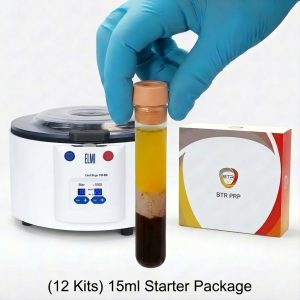
A spun tube showing an unusually thin or absent buffy coat, hazy plasma, or red tinge bleeding into the plasma layer is signaling that the spin failed, and that prep should never go into a patient.